

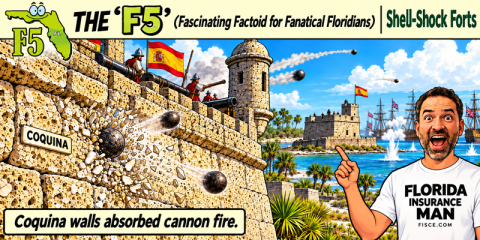
On October 15, 1924, President Calvin Coolidge designated two historic Spanish fortifications near St. Augustine as national monuments.
The sites were Castillo de San Marcos and Fort Matanzas National Monument.
What makes these forts remarkable is their construction material.
Both were built from coquina, a porous limestone composed largely of compressed seashells.
You might expect seashell walls to crumble under cannon fire. Instead, coquina's unusual structure made the fortifications surprisingly resistant to bombardment.
When cannonballs struck the walls, the stone often compressed and absorbed the impact rather than shattering like conventional masonry.
During a British attack on St. Augustine in 1702, the Castillo's coquina walls successfully withstood bombardment.
According to the National Park Service, these are the only two surviving fortifications in the world built from this unusual type of limestone.