

Sources referenced in this article:
- Florida Statutes: Section 626.2815—Continuing Education Requirements
- Florida DFS: Continuing Education for Agents and Adjusters
- Florida DFS: Education Center—June 2025
- Florida DFS: MyProfile Information and Tutorials
- Florida DFS: MyProfile Portal
“Which four-hour Law and Ethics course am I supposed to take?”
It sounds like a simple question. Then someone opens the Florida licensing alphabet soup and finds a 2-20 license, a 5-220 course authority and several similarly named update courses.
The important point is that Florida does not use one universal four-hour update course for every insurance professional. The correct course depends on the license—or combination of licenses—the professional holds.
Thankfully, the Florida Department of Financial Services has published a current continuing-education guide that matches each license type to the appropriate update-course authority. Because most agents have more urgent plans than decoding every 2-xx and 5-xxx number over lunch, here is the short version.
The Short Version
- Covered Florida licensees generally complete a four-hour update course every two years in addition to any required elective hours.
- The course must be specific to a license the professional holds and approved under the correct authority.
- A person holding multiple licenses generally completes an update course for at least one of those licenses—not a separate update course for every license.
- A course approved under the wrong authority may count only as elective credit and leave the four-hour requirement deficient.
- The professional’s current MyProfile CE Status and transcript should be the final checkpoint before registration.
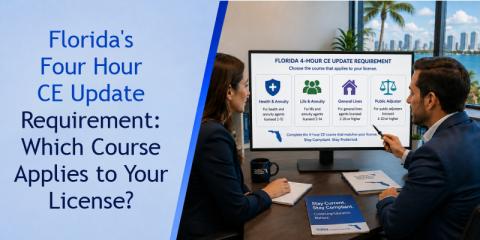
Which Four-Hour Course Authority Applies?
Florida DFS currently identifies the following update-course authorities. The course-authority number is not the professional’s license number; it identifies the approval category under which the course is offered and reported.
|
Course authority |
Update category |
Licenses identified by DFS |
|
5-215 |
Life, Health and Annuity |
2-15 and 2-18 |
|
5-214 |
Life and Annuity |
2-14 and 2-16 |
|
5-240 |
Health |
2-40 |
|
5-220 |
General Lines |
2-20, 20-44, 4-40, 4-42 and 2-33 |
|
5-620 |
Adjuster |
6-20, 5-20, 7-20 and 70-20 |
|
5-320 |
Public Adjuster |
3-20 |
|
5-237 |
Bail Bond |
2-34 and 2-37 |
For example, a 2-20 general lines agent should generally look for a four-hour update course carrying the 5-220 authority. An all-lines adjuster should look for the appropriate 5-620 course. The similar-looking numbers are related—but they are not interchangeable.
What If You Hold Multiple Florida Licenses?
Under Section 626.2815, Florida Statutes, a licensee holding multiple insurance licenses must complete an update course specific to at least one license held. Florida DFS gives the same direction in its current CE guidance.
Consider a professional who holds both a 2-20 general lines license and a 2-15 life, health and variable annuity license. That person generally does not need both a 5-220 General Lines update and a 5-215 Life, Health and Annuity update during the same compliance period. A qualifying update course for either license can satisfy the four-hour update requirement.
That does not mean any four-hour course will work. The selected course still must correspond to at least one license the professional actually holds, and any remaining elective-hour requirements still apply.
What Happens If You Take the Wrong Update Course?
Florida DFS warned in its June 2025 Education Center guidance that an update course completed under an authority that does not match the licensee’s type of license will be allocated to elective credit. It will not satisfy the four-hour update requirement.
That can create the especially frustrating situation in which the transcript shows enough total hours while the update category remains deficient. The words “Law and Ethics” in a course title are not enough by themselves; the approved authority must match.
Why MyProfile Gets the Final Say
A statewide chart explains the general rule. It cannot show an individual professional’s licenses, deadline, prior courses or current deficiencies. Florida DFS therefore tells licensees to monitor their own CE records through MyProfile.
Before registering, use MyProfile to:
- Review CE Status and the authority that can satisfy the four-hour requirement.
- Check the transcript for courses already completed and reported.
- Search for approved courses and confirm the provider and course authority.
- Identify the compliance deadline and any other deficient categories.
DFS also cautions that completing the same course within 24 months will not produce additional credit. The duplicate may appear on the transcript without being allocated. Its MyProfile tutorials explain how to review CE Status, transcripts and approved courses.
After completing a course, check the record again. Florida law and DFS guidance allow providers up to 21 days to report completion, so a course may not appear immediately.
What About Title Agents and Other Exceptions?
Title agents do not follow the same four-hour update structure. Florida law establishes a separate 10-hour biennial requirement for title agents, including three hours in ethics, rules or compliance and seven additional hours in title insurance and escrow management. DFS currently identifies CE9908 for the three-hour title-specific component.
Florida law also includes special provisions for certain nonresident licensees and active-duty military members. Limited licenses and unusual license combinations can raise different questions. If MyProfile does not clearly show what applies, DFS directs licensees to contact its Education unit at Education@MyFloridaCFO.com.
A Five-Minute Registration Check
Before selecting a Florida 4-hour CE update course:
- List your current Florida licenses. Do not rely on the license you use most often.
- Open MyProfile CE Status. Confirm the authority and compliance deadline shown for you.
- Verify the course approval. Match its authority to at least one license you hold.
- Review your transcript. Make sure you have not completed the same course within the past 24 months.
- Check after completion. Confirm that the credit is reported and applied to the correct requirement.
The Bottom Line
Florida’s four-hour update requirement is not satisfied merely by choosing a course with “Law and Ethics” in the title. The course authority must correspond to at least one license the professional holds.
For professionals with multiple licenses, one correctly matched update course will generally satisfy the update category. For everyone, the best final check is the same: review the current DFS guidance, then confirm the individual requirement and transcript in MyProfile before registering.
For a broader overview, visit FISCE’s guide to Law and Ethics CE Requirements for Florida Insurance Agents or review FISCE’s CE compliance resources.
FISCE offers live, instructor-led Law and Ethics update webinars for several Florida license categories. Before registering, review the “Approved Licenses” shown with the course, then view the upcoming webinar schedule and register.
This article summarizes information published by the Florida Department of Financial Services and the Florida Legislature. Information and links were reviewed on August 31, 2026. Laws, administrative requirements, course approvals and individual compliance records can change. Licensees should review their current Florida DFS MyProfile account and contact DFS when clarification is needed.